
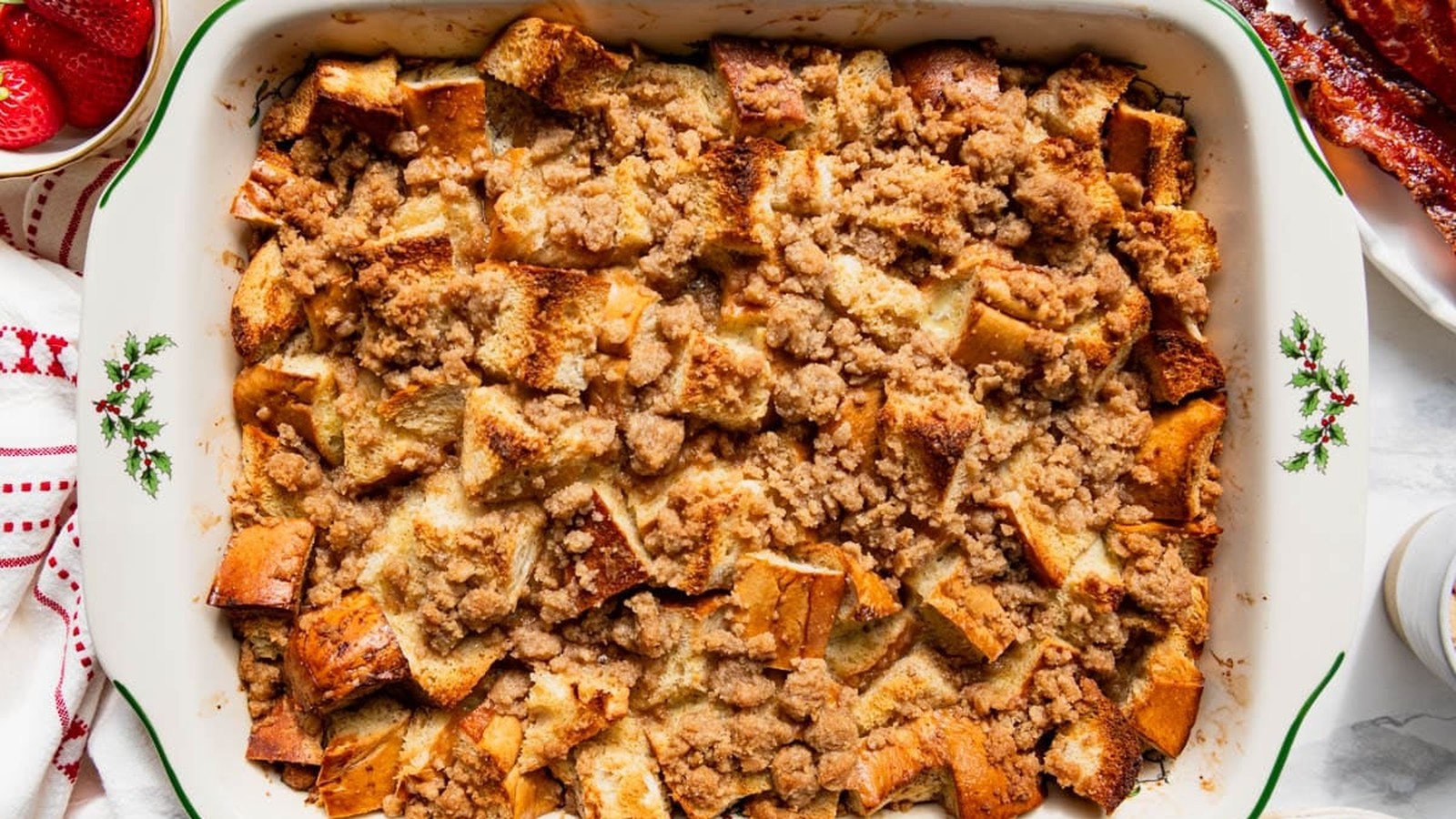
Christmas morning should smell like cinnamon and brown sugar, not stress — and this french toast casserole recipe is how you get there. Everything is assembled the night before: cubes of rich brioche soaked in a vanilla-cinnamon custard, tucked into a baking dish and left in the fridge while you sleep. In the morning, all that is left is a buttery pecan crumble on top and 50 minutes in the oven while the presents are opened.
What comes out is the best of both worlds: a crisp, caramelised top with the soft, custardy middle of a bread pudding, cut into generous squares and served warm with maple syrup. It feeds 8 to 10 people from a single dish, which is exactly what a holiday breakfast should do — nobody standing at the stove flipping slices while everyone else eats.
Prep time: 20 minutes · Chill time: 8–12 hours (overnight) · Cook time: 50 minutes · Total time: about 9 hours 20 minutes · Serves: 8–10 · Cubes of brioche soaked overnight in a cinnamon-vanilla custard, baked under a buttery brown sugar and pecan crumble.

Image credit: MomsDish / momsdish.com
Why This French Toast Casserole Works
The overnight soak is the whole trick. Bread left in custard for 8 hours drinks it up evenly, so every cube bakes into something soft and creamy in the middle instead of dry on top and soggy underneath. Day-old brioche or challah is the right bread for the job because it is rich and sturdy enough to hold its shape after a long soak, where soft sandwich bread would collapse into mush.
The crumble topping does the second job: cold butter rubbed into brown sugar, flour and cinnamon bakes into a crisp, caramelised crust that contrasts with the soft middle, and the pecans toast as it bakes. And because the work happens the night before, Christmas morning is just oven on, topping scattered, bake — breakfast is ready while the coffee brews and the wrapping paper piles up.
Ingredients

Image credit: Love and Lemons / loveandlemons.com
- 1 loaf (about 16 ounces / 450 g) brioche or challah, a day or two old, cut into 1-inch cubes (about 10 cups)
- 8 large eggs
- 1¾ cups (420 ml) whole milk
- ¾ cup (180 ml) heavy cream
- ⅓ cup (67 g) packed light brown sugar
- 2 tablespoons pure maple syrup
- 2 teaspoons vanilla extract
- 1½ teaspoons ground cinnamon
- ¼ teaspoon ground nutmeg
- ¼ teaspoon fine sea salt
For the crumble topping:
- ½ cup (100 g) packed light brown sugar
- ⅓ cup (40 g) all-purpose flour
- 1 teaspoon ground cinnamon
- ¼ teaspoon fine sea salt
- 4 tablespoons (57 g) cold unsalted butter, cut into small cubes
- ½ cup (60 g) chopped pecans
To serve: maple syrup, powdered sugar, and fresh berries.
A word on the bread, because it decides the texture. Brioche and challah are the classic picks — rich, slightly sweet, and firm enough to survive an overnight soak with their shape intact. A crusty French loaf works well too, and a day or two of staleness is a feature, not a flaw: dry bread absorbs more custard. Skip soft pre-sliced sandwich bread; it soaks up the custard too fast and bakes into a dense, wet slab. For the dairy, whole milk plus cream gives the custard its richness; half-and-half can stand in for the cream, and the maple syrup in the custard is there for flavour rather than sweetness — the topping and the syrup at the table do the sweetening.
How to Make French Toast Casserole
- Cube the bread and fill the dish. Butter a 9×13-inch baking dish generously, getting into the corners. Cut the bread into 1-inch cubes — they do not need to be perfect — and spread them in an even layer in the dish, piling any smaller pieces toward the middle so the edges bake evenly.
- Whisk the custard. In a large bowl, whisk the eggs until the yolks and whites are fully combined, then whisk in the milk, cream, brown sugar, maple syrup, vanilla, cinnamon, nutmeg and salt. Keep whisking for a good 30 seconds so the sugar dissolves and the spices are evenly distributed rather than floating in patches.
- Soak the bread — overnight is best. Pour the custard slowly and evenly over the bread cubes, then press them down gently with the back of a spoon or a spatula so every piece gets wet. Cover the dish tightly with foil or plastic wrap and refrigerate for 8 to 12 hours. In a pinch, 4 hours will do; if you are baking the same day, let the dish stand at room temperature for 30 to 45 minutes instead.

Image credit: Love and Lemons / loveandlemons.com
- Make the crumble topping. In a medium bowl, stir together the brown sugar, flour, cinnamon and salt. Add the cold butter cubes and rub them in with your fingertips — or cut them in with a fork — until the mixture looks like coarse, damp crumbs with a few pea-size butter pieces left. Stir in the chopped pecans. Cover and refrigerate until morning, or make it fresh while the oven preheats.
- Morning: preheat and top. Take the casserole out of the fridge 20 to 30 minutes before baking so the dish is not ice-cold going into a hot oven. Preheat the oven to 350°F (175°C). Uncover the dish and scatter the crumble topping evenly over the top, right out to the edges.
- Bake until golden and set. Cover the dish loosely with foil and bake for 25 minutes, then remove the foil and bake for 20 to 25 minutes more, until the top is deep golden, the crumble is crisp, and the centre is set — a knife inserted in the middle should come out mostly clean, and a thermometer should read 160°F (71°C). If the top is browning too fast, lay the foil loosely back over it for the last few minutes.
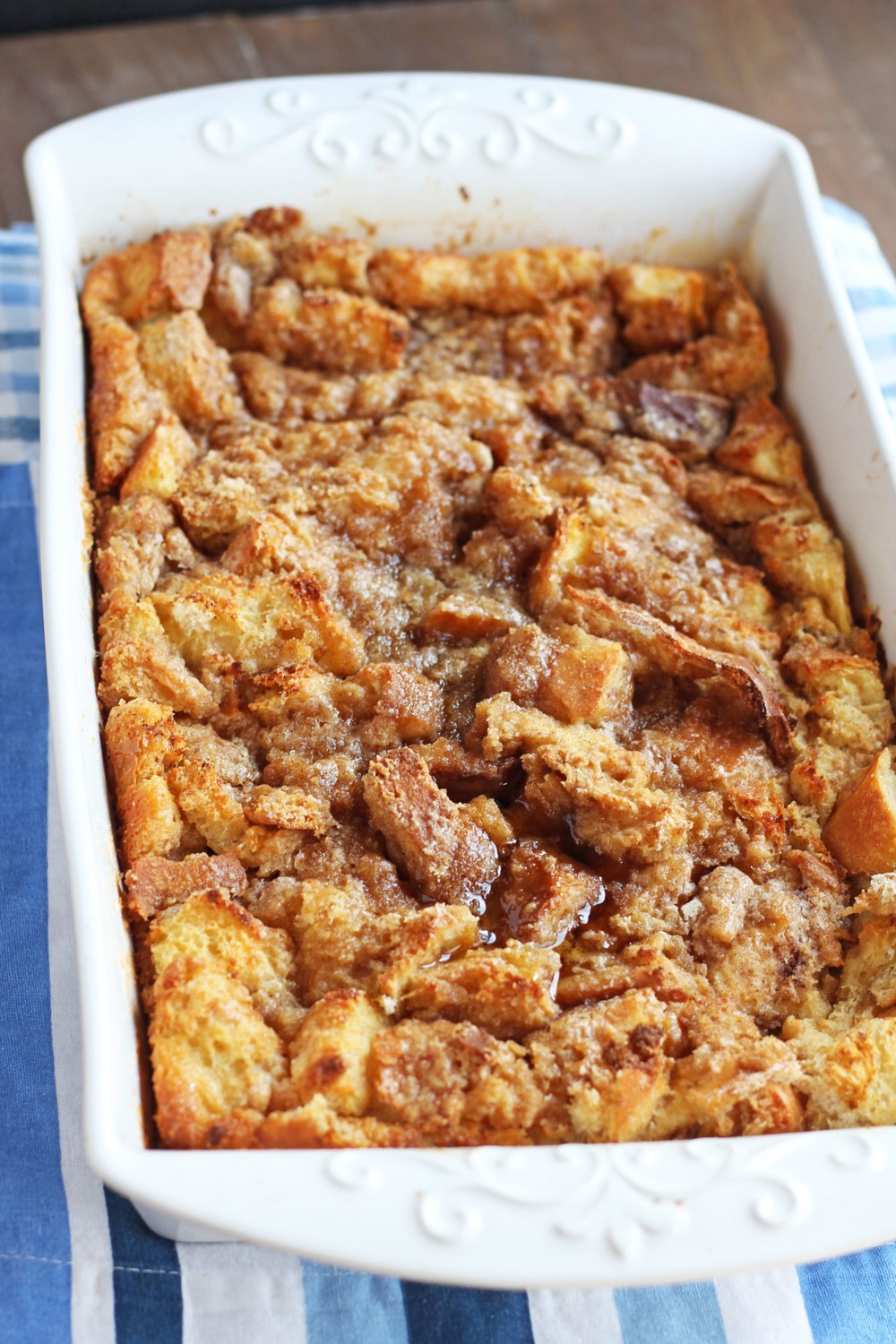
Image credit: Gather for Bread / gatherforbread.com
- Rest and serve. Let the casserole stand for 10 minutes out of the oven so the custard finishes setting and the squares hold their shape when you lift them out. Dust with powdered sugar, cut into squares, and serve warm with maple syrup and fresh berries.

Image credit: Real Food Whole Life / realfoodwholelife.com
Variations: Blueberry, Cream Cheese and Eggnog

Image credit: All the Healthy Things / allthehealthythings.com
Blueberry French toast casserole. Scatter 1½ cups of fresh or frozen blueberries over the bread cubes before pouring in the custard, and add the zest of one lemon to the custard. The berries burst as the casserole bakes and tint the custard faintly purple in the prettiest way; frozen berries go in straight from the freezer, with no thawing needed, and they hold their shape better than fresh ones.
Cream cheese French toast casserole. Spread half the bread cubes in the dish, then dot them with 8 ounces of softened cream cheese beaten with 2 tablespoons of sugar and 1 teaspoon of vanilla. Add the remaining bread and custard on top and proceed as written. The cream cheese melts into sweet, tangy pockets as it bakes — very close to stuffed French toast, with none of the fiddling, and a drizzle of maple syrup is still the right finish.
Eggnog French toast casserole. Replace the milk and cream with 2½ cups of full-fat eggnog and leave out the nutmeg, since the eggnog already carries it. It is the most Christmas-tasting version of the three — rich, warmly spiced, and made for a holiday table. For an even more festive version, scatter ½ cup of dried cranberries and the zest of one orange over the bread before the custard goes on; the tart fruit cuts through the richness beautifully.
Serving Ideas

Image credit: This Silly Girl’s Kitchen / thissillygirlskitchen.com
This casserole arrives at the table already dressed — golden, crumbly and fragrant — so serving it is mostly a matter of what goes alongside. Warm maple syrup is non-negotiable, and a dusting of powdered sugar plus a handful of berries makes each square look like it came from a brunch café. The sweetness wants something salty nearby, so a plate of crisp bacon or sausage links is the classic counterpoint, and the whole spread comes together with almost no extra cooking.
- The classic plate: a square of casserole, powdered sugar, warm maple syrup and fresh berries
- Something savoury on the side: crisp bacon, sausage links, or a simple egg scramble
- For a crowd: a big fruit salad and a pot of coffee — the casserole is the centrepiece, everything else stays simple
- Drinks: coffee, hot chocolate for the kids, or mimosas for a holiday brunch
Storage, Freezing and Make-Ahead
Baked leftovers keep in an airtight container in the fridge for up to 3 days. Reheat covered in a 325°F (165°C) oven until warmed through, or microwave a single portion for a minute or two — the crumble will soften a little on reheating, but the flavour holds. The baked casserole also freezes well for up to 3 months: cool it completely, wrap tightly in foil and then in a freezer bag, thaw overnight in the fridge, and reheat covered until hot. The unbaked, assembled casserole can wait in the fridge for up to 24 hours, which is the whole point of the overnight method — but never leave it at room temperature overnight, since the custard is raw egg and dairy. The crumble topping can be made up to 3 days ahead and kept refrigerated in a sealed container, ready to scatter on in the morning.
French Toast Casserole Questions
Can I make french toast casserole the night before? Yes — that is the whole point of this french toast casserole recipe. Assemble it the evening before, cover tightly and refrigerate for 8 to 12 hours; in the morning, add the topping and bake. The long soak is what makes the middle custardy all the way through, and it turns Christmas morning into a 50-minute wait instead of a cooking session.
What is the best bread for french toast casserole? Brioche or challah, a day or two old. Both are rich and sturdy enough to soak up the custard without falling apart, and their slight sweetness suits the dish. A crusty French loaf is a good third choice; avoid soft sandwich bread, which turns soggy.
Can I bake it the same day instead of overnight? You can. Let the assembled casserole stand at room temperature for 30 to 45 minutes so the bread absorbs the custard, then top and bake as written. The texture will be slightly less even than the overnight version, but it is still very good — just press the bread down well so no dry cubes are left on top.
Tips for the Best French Toast Casserole
Use day-old, sturdy bread. Brioche or challah that has sat out a day or two drinks up the custard without collapsing, and the cubes keep their shape in the oven, which is what gives the finished casserole its texture instead of a uniform, pudding-like slab; if your loaf is fresh, cube it and leave it uncovered on a baking sheet for a few hours, or dry the cubes in a low oven for 10 minutes. Give it the full overnight soak. Eight hours in the fridge lets the custard reach every cube evenly, so there are no dry spots on top and no puddle underneath; if you are short on time, four hours is the honest minimum, and a 30-minute counter rest is the same-day fallback. Bake covered, then uncovered. Foil for the first 25 minutes lets the custard set gently without the top over-browning, and the uncovered finish is what crisps the crumble and toasts the pecans to deep gold. Let it rest before serving. Ten minutes out of the oven lets the custard finish setting, so the squares hold their shape when you lift them out instead of slumping onto the plate, and it is also exactly enough time to warm the maple syrup and set the table.